



Order Polonia Restituta
A state distinction awarded for services to culture.

Zdzisław Beksiński (1929–2005)
A dark visionary who feared death but painted it.
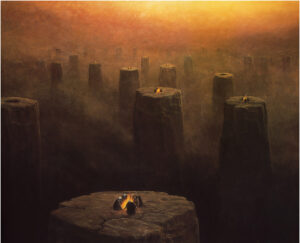
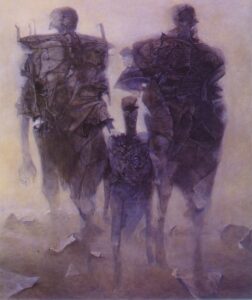
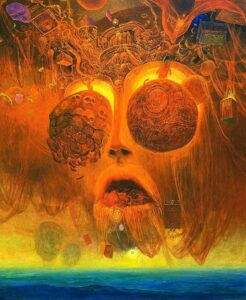
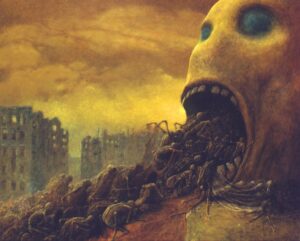
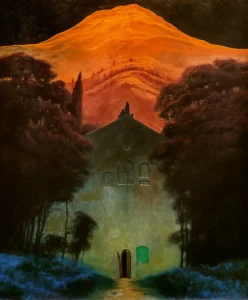
Technique: A master of precise oil painting, he started with experimental photography. In the 1970s, he developed his most famous style – hyperrealistic, fantastic compositions full of ruins, deformed figures, and organic structures. He used an airbrush and fine brushes, achieving an almost “digital” effect long before the Photoshop era.
Private life: He lived like a hermit. He did not travel, was uninterested in galleries or criticism. He painted daily, alone, in silence, often listening to classical or industrial music.
Trivia: He hated interpretations of his paintings. He often said, “I don’t care what you see in my painting. A painting should work like music – emotionally, not through meaning.”
Contemporary significance: Beksiński is today an icon of online visual culture. His works circulate in memes, videos, and computer games. He shows that painting can be as “modern” as digital graphics.
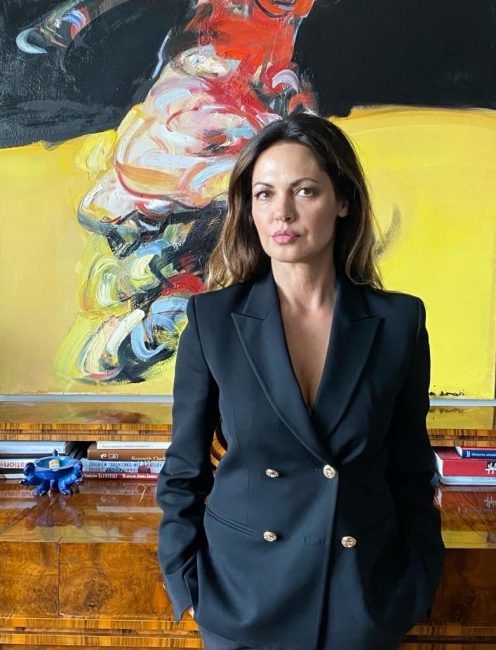 Joanna Piotrowska - Art Advisor & Marszand
Zdzisław Beksiński was a Polish painter, photographer, and sculptor known for his dystopian surrealistic works. He studied architecture but became renowned for his surreal and abstract paintings which depicted eerie, desolate landscapes and disturbing imagery. His style evolved from expressionistic utopian realism to formalist abstraction. Beksiński was also interested in digital photo manipulation later in life. Despite the grim content of his works, he considered some to be optimistic or humorous and refused to title his pieces.
Born in Sanok, Poland, Beksiński studied architecture at Kraków Polytechnic between 1947 and 1952. He initially worked as a construction site supervisor but pursued artistic endeavors in montage photography, sculpting, and painting.
Beksiński created paintings mainly on oil-painted hardboards, experimenting also with acrylics. His works often featured unsettling themes such as torn doll faces, desolate landscapes, and bandage-wrapped portraits. His best-known 'fantastic period' from the late 1960s to mid-1980s expressed surreal environments filled with death and decay imagery. He disliked interpreting his works and avoided titling them.
In the late 1990s, Beksiński embraced new media including digital photography and photo manipulation, exploring virtual reality art until his death.
Beksiński endured personal tragedies including the death of his wife in 1998 and his son's suicide in 1999. He was murdered in his Warsaw apartment in 2005. Known for his modesty and humor, he was inspired primarily by classical music and avoided public appearances.
Polish
Graphics, Painter, Photographer, Sculptor
Dystopian surrealism, baroque and gothic art style, abstract painting, expressionism, surreal architecture, dream photography, digital photo manipulation
A state distinction awarded for services to culture.
Recognition in the artistic community for innovations and contributions to surrealist art.
Awards and exhibitions internationally highlight his importance in contemporary art.
For the use of modern technologies in art.