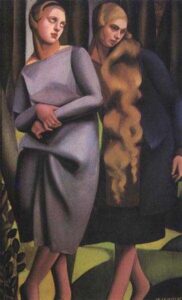







First Prize, Exposition Internationale des Beaux Arts, Bordeaux
Received for her portrait of Kizette on the Balcony.
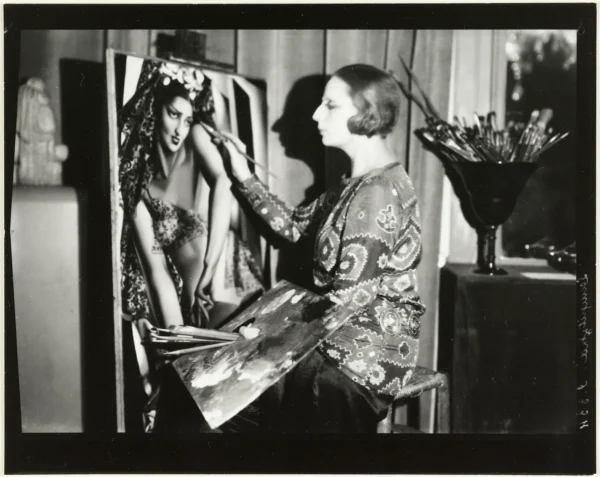
Tamara Lempicka (1898–1980)
Queen of Art Déco – painter of luxury, femininity, and control.
Style: Art Déco – clear contours, geometric shapes, elegance, and cool sensuality. Her female nudes express strength, not submission. La Pologne magazine wrote that Lempicka’s models were modern women. They knew no hypocrisy or shame in bourgeois morality terms. They were sun-kissed and wind-tanned, their bodies taut like Amazons’.
Technique: Painted like a sculptor – sharp shapes, modeling with light, almost marble-like figures.
Life: Fashion icon, friend of aristocrats and artists. Aristocrats and wives of wealthy industrialists commissioned life-sized portraits from her. The volume of commissions led to nearly mass production of paintings. A controversial artist, truly independent, she consciously crafted her distinctive image.
Curiosity: Before the war, she was a painter of celebrities; after the war, she vanished from the art scene for a long time. Her renaissance came only in the 1980s. Today, she is the third most expensive 20th-century female artist. Madonna, Barbra Streisand, Jack Nicholson, and Woody Allen own her paintings.
For us today: Lempicka shows that an artist can control their image – she was an influencer before social media existed.
 Joanna Piotrowska - Art Advisor & Marszand
Tamara Łempicka (1894–1980) was a Polish-born painter best known for her elegant Art Deco portraits and stylized nudes. Educated in Paris, she blended cubism with neoclassical style influenced by Ingres. An influential figure in Parisian interwar art circles, Lempicka's work regained popularity in the late 20th century after initial decline post-WWII.
Born in Warsaw to a Polish-Jewish family, Lempicka was initially trained in Saint Petersburg and later studied in Paris under Maurice Denis and André Lhote, who influenced her refined cubist and neoclassical style.
Lempicka became prominent in the 1920s Paris art scene, exhibiting in major salons and gaining recognition for her portraits of aristocrats and glamorous figures. Her 1927 painting "The Dream" and 1929 self-portrait "Tamara in a Green Bugatti" marked her breakthrough.
After divorcing her first husband, Lempicka married Baron Raoul Kuffner and moved to the US during WWII. She continued painting portraits and experimented with abstract and surrealist elements in later decades.
Though her style fell out of fashion post-WWII, Lempicka's work saw a resurgence in the 1960s. Today she is celebrated as an icon of Art Deco and a pioneering female artist with a lasting cultural impact.
Polish
Painter, Portrait
Polished Art Deco portraits of aristocrats and wealthy, stylized nudes, still lifes, abstract paintings, religious subjects
Received for her portrait of Kizette on the Balcony.
Awarded for a portrait of her daughter Kizette at her First Communion.
Major exhibition signifying the revival of interest in her work.
Eden Espinosa nominated for her portrayal of Tamara in the Broadway musical based on the artist's life.