




First solo exhibition
Held at Ambroise Vollard's Paris gallery, marking the public introduction of Cézanne’s groundbreaking style.
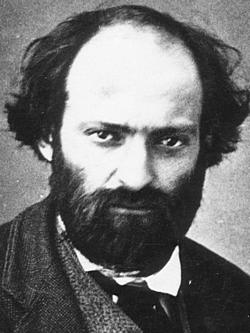
Paul Cézanne (1839–1906)
The father of modern painting. He painted like a sculptor and thought like a philosopher.
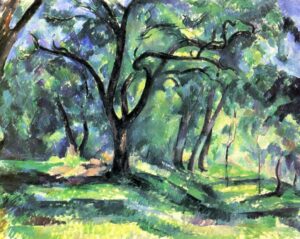
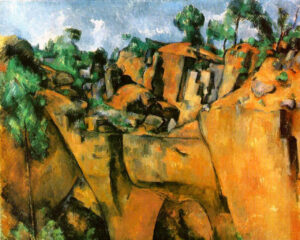
Style: Although he began as an Impressionist, he soon started simplifying forms, viewing nature as a composition of shapes — “the cylinder, the sphere, and the cone.” Cubism grew out of his vision.
Technique: He worked slowly, in layers. For Cézanne, color was not about emotion but structure. He believed a landscape must be “thought through.”
Curiosity: He obsessively painted Mont Sainte-Victoire — the motif appears dozens of times in his work. He treated it like a painter’s laboratory.
Life: A recluse, largely rejected by critics during his early years, he was only appreciated toward the end of his life.
Modern relevance: Cézanne proves that patience, focus, and structural thinking can anticipate entire movements. He’s an artist for those who want to build a painting, not just paint it.
 Joanna Piotrowska - Art Advisor & Marszand
Paul Cézanne was a French Post-Impressionist painter whose work bridged Impressionism and Cubism. He revolutionized traditional artistic methods by emphasizing underlying geometric structure, color modulation, and multiple perspectives. Though initially met with criticism, he influenced many avant-garde movements in the early 20th century and is called ‘the father of us all’ by Picasso. Cézanne’s pioneering exploration of form and color profoundly shaped modern art.
Born in Aix-en-Provence to a wealthy banker, Cézanne showed early artistic talent and studied at the Académie Suisse and Aix-Marseille University. He was classmates with Émile Zola. Despite initial opposition from his father, he pursued painting rather than law.
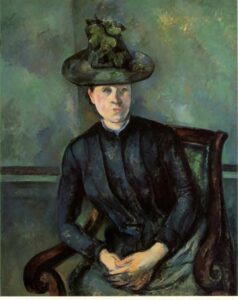
His early works were influenced by Romanticism and Realism. He developed a unique pictorial language focusing on geometric simplification, color planes, and rejecting traditional linear perspective. Known for repetitive brushstrokes building form, he evolved from dark tonal paintings to bright, structured landscapes and still lifes.
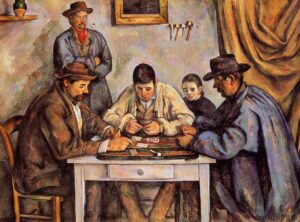
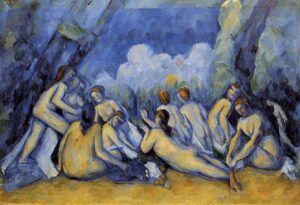
Cézanne’s major periods include the ‘dark period’ (1861–1870), Impressionist period (1870–1878), mature period (1878–1890), and final period (1890–1906). Notable works include 'Mont Sainte-Victoire' series, 'The Card Players', 'The Bathers', and various still lifes featuring skulls and fruit.
Initially rejected by official saloons, Cézanne found support among fellow artists and dealers like Camille Pissarro and Ambroise Vollard who mounted his first solo exhibition in 1895. His painting gradually gained recognition and was collected by major galleries and patrons.
French
Painter, Painting, Post-Impressionist
Post-Impressionism, Representation of nature as geometric forms, Still lifes, Bathers, Mountain landscapes
Held at Ambroise Vollard's Paris gallery, marking the public introduction of Cézanne’s groundbreaking style.
Berlin National Gallery acquired 'The Mill on the Couleuvre near Pontoise', the first museum purchase of his work.
Exhibitions at Bernheim-Jeune gallery and Salon d’Automne celebrated Cézanne and influenced emerging modernists.