




Cyprian Kamil Norwid Critics Award
Award for outstanding artistic achievements.

Jerzy Duda-Gracz (1941–2004)
An ironic commentator on Polish reality and a master of the grotesque, he turned ugliness into something beautiful and true.
Style and Technique:
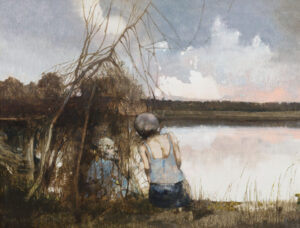
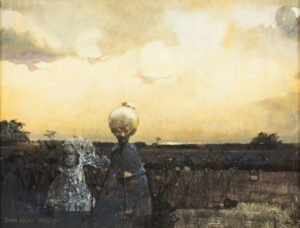
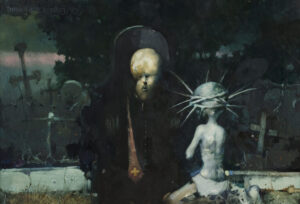
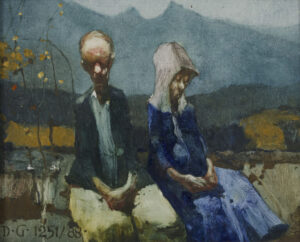
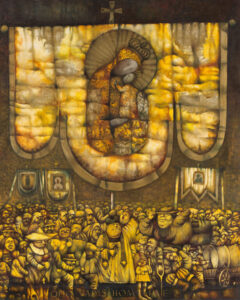
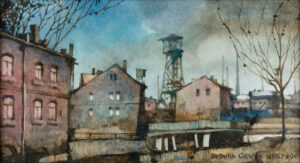
He worked with precise drawing and a cool color palette, often using pastels, acrylics, and oils. He created what he called “deformed figurative painting” – exaggerated figures, often steeped in grotesque and ugliness, yet infused with strong emotional and symbolic meaning.
Themes:
The Polish countryside, kitschy PRL-era folklore, religion, folk culture, and the absurdity of everyday life. He was like the Goya of contemporary Poland – painting society through the lens of a moralist, but not without tenderness. He once said of himself: “I am sick with Poland.”
Mysteries and Interesting Facts:
He detested empty, pompous declarations in art – for him, the message and emotion were paramount.
He painted several series dedicated to themes like “Golgotha,” “Chopin,” and the “Black Madonna of Częstochowa,” proving that one could be a religious artist without falling into pathos.
Some of his works were censored in the Polish People’s Republic for being too blunt or provocative.
What does he tell us today?
Duda-Gracz teaches us that true art isn’t about beautifying – it’s about telling the truth, even when it’s uncomfortable.
 Joanna Piotrowska - Art Advisor & Marszand
Jerzy Duda-Gracz was a Polish painter, draftsman, scenographer, and professor known for his satirical, moralizing art depicting caricaturally distorted human figures and addressing social vices. He graduated from the Jan Matejko Academy of Fine Arts in Krakow and taught art in various institutions. His work evokes strong emotions and is influenced by symbolism and grotesque traditions.
Born on 20 March 1941 in Częstochowa, Poland. Graduated from the State High School of Fine Arts in Częstochowa and then the Faculty of Graphics at the Jan Matejko Academy of Fine Arts in Krakow, Katowice branch in 1968.
Duda-Gracz was known for multi-element compositions and exploring moral and social themes through sharp symbolism, satire, and grotesque imagery. His paintings often expose human flaws such as ignorance, intolerance, deceit, crudeness, and materialistic obsession. His works are numbered and dated for authenticity.
Taught at the Faculty of Graphics between 1976-1982. Later lectured at the European Academy of Arts in Warsaw (1992-2001) and at the Faculty of Radio and Television of the University of Silesia in Katowice until his death. Received the title of professor in 2001.
Famous works include 'In Memory of Father' (1970), 'Letter to the West' (1973), 'Riders of the Apocalypse, or the Gig' (1977), 'Polish Calendar' (1981), and 'Christmas Eve' (1981). Created extensive cycles like 'Motifs and Polish Portraits' and 'Chopinowi', his detailed painted interpretation of Chopin's compositions.
Polish
Draftsman, Graphics, Painter, professor, scenographer
symbolism, satire, grotesque, human folly, social critique
Award for outstanding artistic achievements.
Recognition by the Prime Minister for contributions to the arts.
Prestigious national award for cultural contribution.
One of Poland's highest honors for artists.