




Grand Prix of São Paulo Biennale
Awarded at the São Paulo Art Biennial, Brazil, recognizing international significance in contemporary art.

Magdalena Abakanowicz (1930–2017)
Visionary of soft forms, sculptor of solitude and collective identity, a total artist.
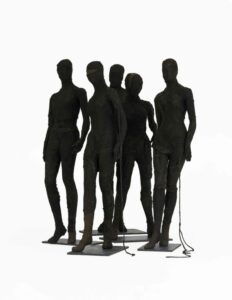
Style and technique: Best known for monumental fabric sculptures called Abakans that revolutionized the concept of sculpture. Later, she also created figures from resin, wood, bronze – anonymous human crowds, often headless.
Themes: The human body, its fragility, individuality versus collectivity. Her works meditate on totalitarianism, war, and loneliness.
Secrets and trivia:
In childhood, she experienced Soviet occupation and the Warsaw Uprising – war was her primary experience.
The Abakans—named after her surname—gained worldwide fame, exhibited at the Venice Biennale, MoMA, and the MET.
She created entire armies of sculptures, e.g., the famous Crowds — rows of impersonal figures standing motionless as if after a catastrophe.
What does she tell us today? That art can speak through form even without words – her sculptures are like a scream encoded in matter. Abakanowicz is a symbol of art that does not flee from pain but transforms it into something universal.
 Joanna Piotrowska - Art Advisor & Marszand
Magdalena Abakanowicz (1930–2017) was a Polish sculptor and fiber artist renowned for her innovative use of textiles as sculptural mediums and large-scale outdoor installations. Her work ranged from three-dimensional fiber pieces called Abakans to monumental humanoid sculptures exploring human anonymity and mass. A leading figure of postminimalism, she gained international acclaim for her evocative and tactile art during the postwar era.
Born into a noble family in Falenty, Poland, Abakanowicz's early years were marked by WWII and Nazi occupation with her family involved in Polish resistance. After the war, she studied at the Academy of Fine Arts in Sopot and Warsaw from 1950 to 1954 amidst the imposition of Socialist Realism. Despite a restrictive art environment, she developed skills in weaving and fiber art, paving the way for her unique sculptural textile works.
During the late 1950s and 1960s, influenced by a political thaw and exposure to Western art, Abakanowicz evolved from biomorphic paintings to experimental fiber art. She gained recognition with her large three-dimensional fiber sculptures called 'Abakans', which challenged traditional art boundaries and utilized unconventional materials like sisal ropes and horsehair, reflecting postminimalist aesthetics.
In the 1970s and 1980s, her work shifted towards figurative sculptures made from sewn sackcloth and resins creating headless, faceless human forms that expressed themes of anonymity, conformity, and individual struggle under oppressive regimes. These works, such as 'Alterations', 'Heads', and 'Crowd I', explore the relationship between the individual and the mass, echoing her experiences under communist Poland.
From the late 1980s, Abakanowicz incorporated bronze, wood, and stone, producing notable public artworks such as 'Agora' in Chicago (comprised of 106 cast iron figures) and 'Birds of Knowledge of Good and Evil' in Milwaukee. Her sculptures often symbolize nature and humanity's complexity, with a focus on crowds and communal identity, realized in large-scale outdoor settings worldwide.
Polish
Contemporary Artist, Fiber Artist, Sculptor
Biomorphic forms, human anonymity and confusion, human mass and crowd, nature, individuality versus multiplicity, war impact and memory
Awarded at the São Paulo Art Biennial, Brazil, recognizing international significance in contemporary art.
Honored for distinguished cultural achievements, awarded in Vienna, Austria.
Prestigious international award recognizing outstanding artists for excellence in arts and culture.
Presented by the International Sculpture Center, acknowledging her influential career in sculpture.